

Business KPIs (Key Performance Indicators) are measurable values that track how effectively your company achieves its strategic objectives. For SMEs, choosing the right KPIs means turning entrepreneurial intuition into data-driven decisions — without getting lost in useless metrics.
In this comprehensive guide, we'll cover what KPIs are, how to choose them, and which ones matter most for each area of your business.
What are business KPIs and why do they matter
A KPI is a quantifiable metric directly linked to a strategic goal. Not all metrics are KPIs: the number of emails sent is a metric; the conversion rate from emails to sales is a KPI.
For SMEs, business KPIs are essential because they:
- Objectify decisions — replace gut feelings with numbers
- Align the team — everyone knows what truly matters
- Anticipate problems — a declining KPI is an early warning
- Measure progress — you know if you're hitting quarterly targets
How to choose the right KPIs: the SMART framework
You don't need 50 performance indicators. You need 5-10 KPIs that are:
- Specific — measure a precise aspect (not "general performance")
- Measurable — have an objective numerical value
- Achievable — the target is realistic for your company
- Relevant — linked to actual strategic objectives
- Time-bound — measured over a defined period (month, quarter)
The most common SME mistake is tracking too many KPIs. It's better to monitor 7 indicators weekly than 30 annually.
The 15 essential business KPIs for SMEs
Financial KPIs
- Monthly revenue — total income, compared year-over-year
- Gross margin % — (Revenue - Direct Costs) / Revenue × 100. Shows true product/service profitability
- Operating cash flow — money flowing in and out from ordinary operations. For SMEs, this matters more than revenue
- DSO (Days Sales Outstanding) — average days to collect invoices. If you exceed 90 days, you have a liquidity problem
Sales KPIs
- Conversion rate — accepted quotes / quotes sent. For more details, read our guide to sales and commercial KPIs. A good B2B SME benchmark is 20-30%
- Average order value — revenue / number of orders. If it drops, you're attracting less profitable customers
- Customer Acquisition Cost (CAC) — how much you spend to acquire a new customer
- Customer Lifetime Value (CLV) — what a customer is worth over time. The CLV/CAC ratio should be at least 3:1
Operational KPIs
- Lead time — time from order to delivery. Lower means happier customers
- Defect rate — defective products / total products. For manufacturing, below 1% is the goal
- Revenue per employee — revenue / headcount. Measures overall efficiency
Customer KPIs
- NPS (Net Promoter Score) — how likely customers are to recommend you (scale -100 to +100)
- Retention rate — repeat customers / total customers. Acquiring a new customer costs 5-7x more than keeping one
- Average response time — how long it takes to respond to requests/complaints
HR KPIs
- Employee turnover — resignations / average headcount × 100. Above 15% signals workplace culture issues
How to monitor KPIs: from Excel spreadsheets to BI dashboards
Many SMEs start with Excel, and that's perfectly fine. But when your business KPIs come from different sources (ERP, CRM, e-commerce, accounting), manual updates become unsustainable.
A Business Intelligence dashboard solves this by automatically connecting all data sources and updating KPIs in real time. With Leviathan BI, for example, you can create a dashboard that unifies data from SAP, TeamSystem, Shopify, and your CRM in a single view.
The main advantage: your performance indicators are always up-to-date through automatic data visualization and accessible to those who need them, without waiting for someone to update a file.
Common KPI mistakes
- Measuring everything — too many KPIs = no focus. Choose those that drive decisions
- Vanity metrics — social followers, website visits without conversion. They measure ego, not business
- KPIs without targets — "monthly revenue" isn't a KPI if you don't have a numerical goal
- Not updating KPIs — indicators must evolve with strategy. Review quarterly
- Departmental silos — sales KPIs don't talk to production KPIs. You need cross-functional metrics
Template: your first KPIs in 30 minutes
If you're starting from scratch, here's how to set up your business KPIs today:
- Identify 3 strategic objectives for next quarter (e.g., increase revenue, reduce delivery times, improve margins)
- For each objective, choose 2 KPIs (e.g., revenue: monthly revenue + quote conversion rate)
- Define the target for each KPI (e.g., monthly revenue: +10% vs previous year)
- Set the monitoring frequency (weekly for operational KPIs, monthly for financial)
- Choose your tool: Excel to start, BI platform when data sources multiply
Conclusion
Business KPIs aren't a theoretical exercise: they're the practical tool that transforms raw data into smart decisions. For an SME, 7-10 well-chosen performance indicators are worth more than 100 monthly reports nobody reads. For marketing-specific KPIs, see our dedicated guide.
Start with few KPIs, measurable and linked to your real objectives. Integrate KPI monitoring into your management control system for a complete view. When you're ready to centralize monitoring, contact us to see how Leviathan BI can automate your KPI dashboards.
Related articles
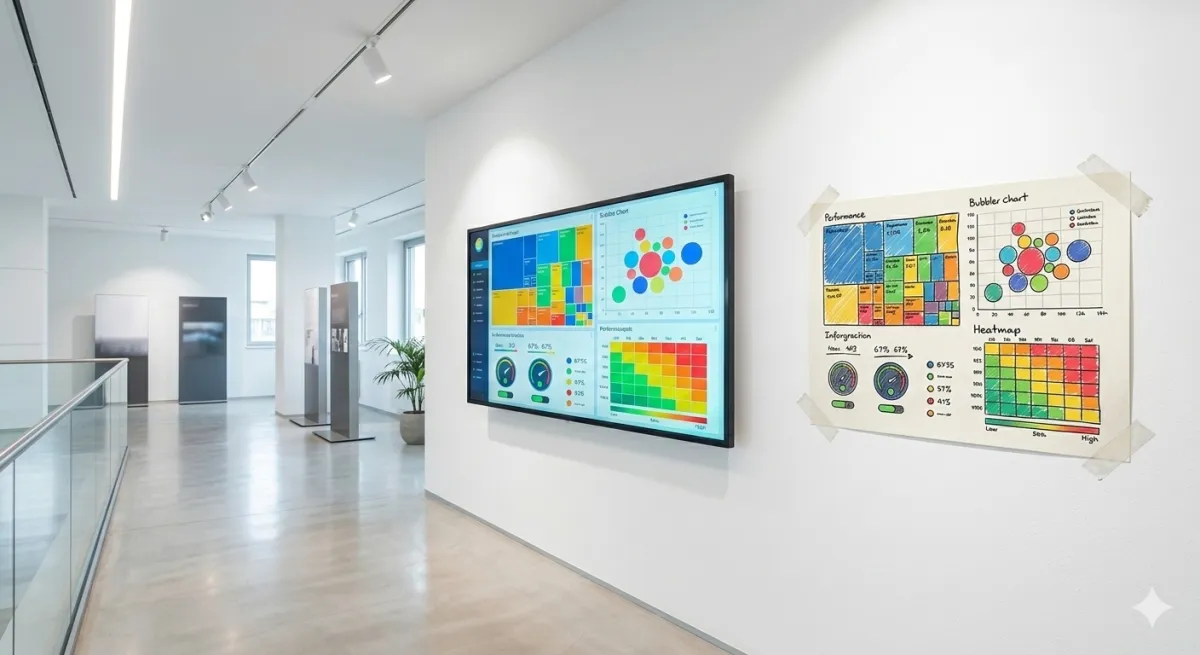
Data visualization: a guide to business charts for SMEs
Data visualization transforms raw numbers into immediate insights. Discover the 7 essential business charts, rules for effective visualizations, and mistakes to avoid.

Cost accounting for SMEs: practical guide 2026
Cost accounting tells you what you really earn per product, customer and project. Learn how to implement it in SMEs without drowning in Excel.
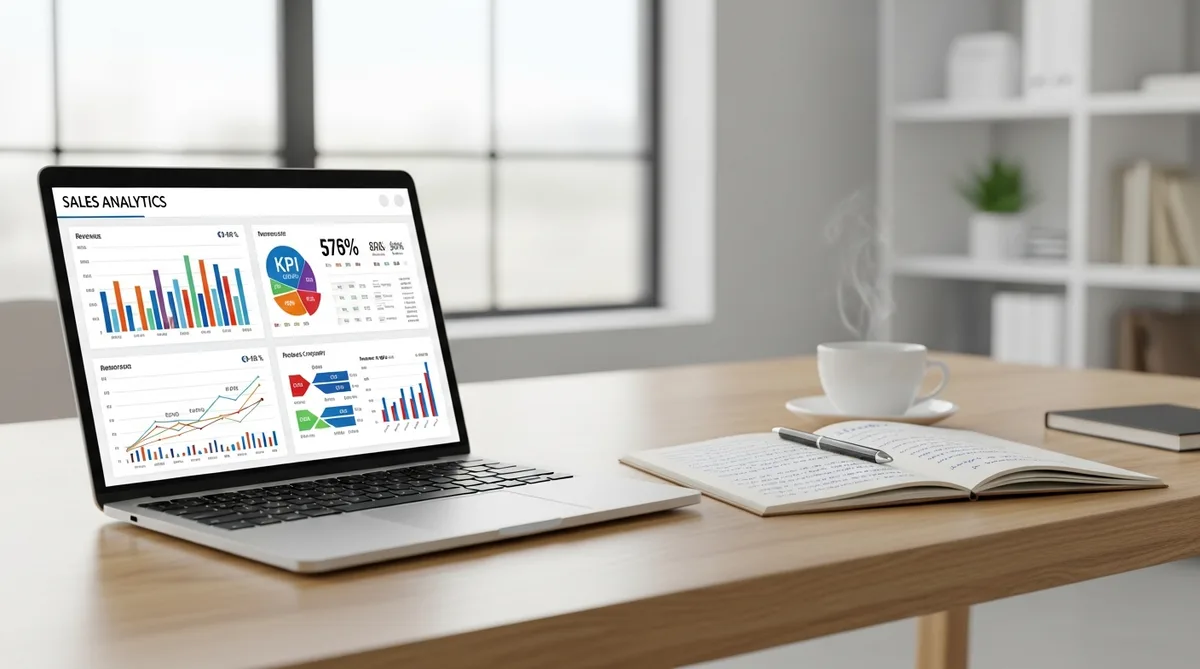
Sales Analysis for SMEs: A Practical 5-Step Guide
How to analyze your SME sales in 5 practical steps: from data collection to segmentation, from trend analysis to concrete actions. Method, tools, and ready-to-use templates.