
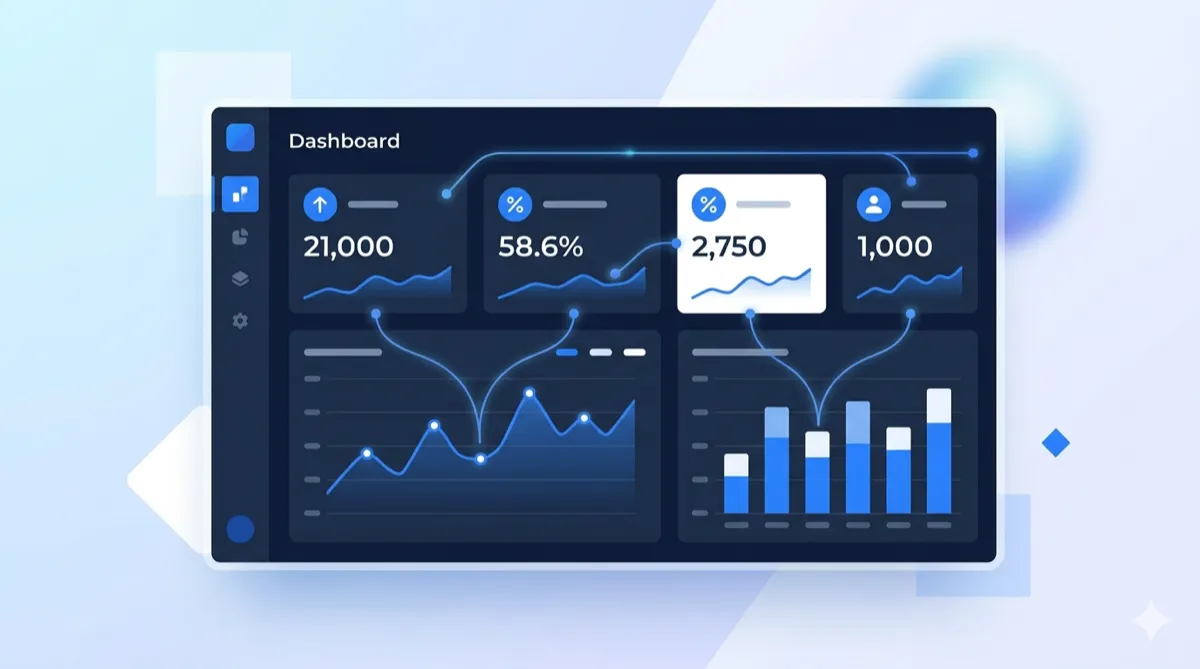
In 2026, artificial intelligence is no longer science fiction: it's a concrete tool that businesses use every day to sell more, spend less, and make better decisions. Yet, for most SMEs, AI remains a vague concept, something reserved for "big companies."
The reality is different. When AI is integrated with Business Intelligence, even an SME with 5 employees can gain advantages that were previously reserved for corporations: automatic sales forecasting, intelligent customer segmentation, and anomaly alerts on data. All without a data scientist on staff.
In this guide, we'll look at how AI applied to BI actually works, the concrete applications for SMEs, and — most importantly — the first step to take to truly leverage it.
What is artificial intelligence in Business Intelligence
Traditional Business Intelligence answers the question: "What happened?". It shows you revenue, margins, trends, variances. It's your company's dashboard.
Artificial intelligence adds three extra capabilities:
- Why did it happen? — AI analyzes correlations between thousands of variables and identifies the causes behind a sales drop or cost increase
- What will happen? — predictive models analyze historical data to forecast sales, demand, churn, and cash flow
- What should I do? — AI suggests concrete actions: reorder a product, contact an at-risk customer, shift budget to a higher-performing channel
In practice, AI transforms BI from a rearview mirror into a navigator: it doesn't just tell you where you've been, but where you're heading and which road to take.
Why 2026 is the right year for SMEs
Until 2024, implementing AI in business required data scientists, dedicated infrastructure, and six-figure budgets. Today, the situation has changed dramatically:
- The Italian AI market grew 50% in one year (source: Politecnico di Milano Observatory), a sign that adoption is mainstream
- Cloud BI platforms integrate AI features natively, with no extra costs or technical expertise needed
- Only 7% of small Italian businesses are using AI (source: I-Com). Those who move now gain an enormous competitive advantage
- Costs have plummeted: a cloud BI platform with advanced analytics starts at €20/month per user
Google itself has called 2026 "the year of concrete AI value for Italian businesses." This isn't hype: these are ready-to-use tools that the smartest SMEs are already adopting.
5 concrete AI applications in Business Intelligence for SMEs
Here's how artificial intelligence transforms data analysis into concrete, revenue-generating actions.
1. Automatic sales forecasting
Instead of estimating sales by "gut feeling," AI analyzes your historical data (seasonality, trends, correlations) and generates accurate forecasts for the coming months.
Concrete example: you run an e-commerce with 500 products. AI analyzes 2 years of data and tells you that product X will see a demand spike in 3 weeks, based on seasonal patterns. You order from the supplier in advance and avoid stockouts.
With a platform like Leviathan BI, your sales data is already centralized and clean: the analytics engine identifies trends, seasonality, and anomalies automatically, giving you a solid foundation for every forecast.
2. Intelligent customer segmentation
Traditional RFM analysis (Recency, Frequency, Monetary) segments customers into static groups. AI makes it dynamic: it identifies customer clusters that share non-obvious behaviors, and updates segments in real time.
Concrete example: AI discovers that customers who buy product A and then product B within 30 days have a lifetime value 3x higher than average. You create a targeted promotion to accelerate that journey.
Leviathan BI already provides the segmentation and KPIs you need to analyze customers by value, frequency, and churn risk — the foundation for any AI strategy.
3. Automatic anomaly detection
Manually checking hundreds of metrics every day is impossible. AI monitors all your data 24/7 and alerts you when something falls outside normal patterns.
Concrete example: the margin on a product category drops 12% in one week. Without AI, you notice it at month-end in the report. With AI, you receive an alert the same day and discover a supplier raised prices without communicating it.
4. Self-writing reports and dashboards
How much time do you spend each week preparing reports? AI generates automated reports with natural language commentary: not just numbers, but interpretations.
Concrete example: every Monday morning, you find a report in your inbox that reads: "Revenue grew 8% vs. previous week, driven by the online channel (+15%). Warning: gross margin dropped to 32%, below the 35% average. Probable cause: the promotion on brand X."
With Leviathan BI, dashboards update every 15 minutes with unified data from all your systems — ERP, e-commerce, CRM. No more copy-pasting between Excel files.
5. Stock optimization and smart reordering
For e-commerce and retail, AI applied to BI solves one of the most costly problems: having too much stock (tied-up capital) or too little (lost sales).
Concrete example: AI analyzes sales velocity, supplier lead times, seasonality, and storage costs for each SKU. The result is an optimized reorder list that maximizes revenue and minimizes tied-up capital.
Leviathan BI already includes a Smart Reorder module that automatically calculates reorder quantities and timing based on your actual sales and inventory data.
The prerequisite 90% of SMEs ignore
Here's the uncomfortable truth: AI without clean data is useless.
You can buy the best AI software in the world, but if your data is scattered across 5 Excel files, an ERP with inconsistent product codes, and an outdated CRM, AI can't do anything useful. Garbage in, garbage out.
The first step — and the most important one — isn't AI. It's data centralization and cleansing:
- Unify data sources — connect your ERP, e-commerce, CRM, and banking in a single platform. No more manual export/import
- Clean the data — standardize product codes, customer names, categories. A serious BI system does this automatically during import
- Build history — AI needs at least 12-24 months of historical data for reliable forecasts. The sooner you start collecting, the sooner you can use AI
- Automate updates — data must be fresh. A 15-minute sync beats a weekly Excel export
Leviathan BI does exactly this: it connects to your systems (ERP, e-commerce, CRM, databases), unifies data automatically, and keeps it updated every 15 minutes. It's the foundation for any AI strategy — and it works from day one, even without AI.
How to choose an AI-ready BI platform
Not all Business Intelligence tools are equal. Here are the criteria for choosing a platform that prepares you for AI:
| Criterion | Why it matters for AI | What to look for |
|---|---|---|
| Data centralization | AI needs all data in one place | Native connectors for ERP, e-commerce, CRM |
| Data quality | Garbage in, garbage out | Automatic validation at import |
| Frequent updates | Forecasts on old data are useless | Sync every 15 minutes or less |
| Complete history | 12-24 months needed for predictive models | Historical data backfill at setup |
| Open APIs | To integrate external AI models | Documented REST APIs |
| Cloud native | Scalability for AI workloads | Cloud infrastructure with EU servers |
| Sustainable cost | AI adds to BI, doesn't replace it | Transparent pricing, from €20/user/month |
Leviathan BI meets all these criteria: connectors for major Italian ERPs and e-commerce platforms, automatic sync every 15 minutes, full historical import, European servers, and transparent pricing at €20/month per user. Try it free.
AI and BI: what it really costs for an SME
The good news: you don't need massive investments. Here's a realistic cost comparison:
| Approach | Annual cost (5 users) | Skills required | Setup time |
|---|---|---|---|
| Excel + macros | €0 (but hours of manual work) | Advanced Excel | - |
| Cloud BI (e.g., Leviathan BI) | €1,200 - €2,400 | None | Hours/days |
| BI + integrated AI | €2,400 - €6,000 | Minimal | Days/weeks |
| Custom AI (data scientist) | €40,000 - €80,000+ | Dedicated team | Months |
The smartest path for an SME? Start with a cloud BI platform that centralizes your data, then add AI capabilities as you need them. Not the other way around.
Think of it like building a house: first the foundation (clean, centralized data), then the upper floors (advanced analytics and AI). Trying to put AI on top of dirty, scattered data wastes time and money.
If you're still using Excel for data analysis, switching to a BI platform is the single highest-ROI investment you can make. And when you're ready for AI, your data will already be prepared.
5 mistakes to avoid
- Buying AI before BI — without centralized data, any AI model produces useless results. Foundation first
- Waiting to have "enough data" — you already have data in your ERP and e-commerce. The problem isn't quantity, it's that data is scattered and disconnected
- Chasing the perfect solution — you don't need the most advanced tool on the market. You need one that works from day one and grows with you
- Ignoring training — even the most beautiful dashboard is useless if the team doesn't look at it. Dedicate 1 hour to initial training
- Not defining KPIs before starting — first decide what to measure, then choose the tool. Not the other way around
Conclusion
Artificial intelligence applied to Business Intelligence is no longer a question of "if," but "when." And for Italian SMEs, the time is now: the tools are accessible, costs are sustainable, and first movers gain a competitive advantage that's hard to close.
But remember: AI doesn't work without clean, centralized data. The first step isn't buying AI software — it's organizing your business data with a BI platform that unifies them automatically.
If you want to get started right away, contact us for a free Leviathan BI demo: we'll show you how to centralize your data in just a few days and build the foundation for a data-driven, AI-ready business.
Related reading: Discover what Business Intelligence is and how to choose the best BI tools for SMEs. If you run an e-commerce, read our guide to BI for e-commerce.
Related articles
Data visualization: a guide to business charts for SMEs
Data visualization transforms raw numbers into immediate insights. Discover the 7 essential business charts, rules for effective visualizations, and mistakes to avoid.

Management control for SMEs: practical tools and method
Management control isn't a big-company luxury. Discover the 5 essential tools to implement it in your SME and how to move from Excel budgets to Business Intelligence.

Business KPIs: Performance Indicators Guide
Business KPIs are the indicators that measure your strategic goal achievement. Discover the 15 essential KPIs for every SME area and how to monitor them effectively.